 EZ Process Pro
What Makes the Best Furniture Software? 10 Things to Check Before You Buy
By Alan Lucien, November 11, 2026

The Short Answer
The best furniture software is built specifically for furniture and mattress retail. It sells today and delivers later, tracks every item from reserved to delivered, pays commission the way you pay it, controls exactly what each employee can see, and runs your point of sale, website, inventory, delivery, and accounting on one database.
Generic software forces you to change your business to fit the software. The right furniture ERP software fits the way your store already runs.
We've spent 25 years building software for furniture and mattress retailers, and we ran our own store before that. Here are the 10 things we'd tell any owner to check before signing anything.
The Best Furniture Software Checklist
Take this list into every demo:
- Can it sell today and deliver later?
- Will it let you run your business the way you already do?
- Can it handle the way you pay commission?
- Can you control exactly what each employee can see and do?
- Can you run the entire business from your phone, anywhere in the world?
- Does it handle the servers, backups, and updates for you?
- Is everything running on one database?
- Is your website built into your software, or separate from it?
- Does it manage delivery, or just record it?
- Does it have accounting and management reporting built in?
Generic Retail Software vs Furniture Software
| What to check | Generic retail software | Furniture software |
|---|---|---|
| Sell today, deliver later | Removes the item from inventory the moment it's sold, as if it were already delivered | Tracks each item as reserved, on order, or delivered until it reaches the customer's home |
| Your rules | Decides for you when sales tax is due and when items get reserved | Lets you choose when sales tax is due and when items get reserved, then follows your rules automatically |
| Commission | Pays one flat rate, so more complex plans end up calculated by hand on a spreadsheet | Calculates your exact commission plan automatically and adjusts it if a sale is refunded or voided |
| Employee permissions | Gives each employee either full access or almost none | Lets you choose exactly which numbers, functions, and screens each employee can see and use |
| Mobile access | Offers a phone app with only a few reports and basic functions | Runs the complete software on your phone, so you can manage everything from anywhere |
| Servers and backups | Leaves servers, backups, and updates for you to manage | Handles servers, backups, and updates for you in the cloud |
| One database | Uses separate systems for the register, website, and accounting that slowly stop matching | Runs the register, inventory, price tags, website, and accounting off one database, so a change in one place updates everywhere |
| Website | Runs a separate website, so prices and availability have to be updated by hand | Shows the same products, prices, and real availability as your showroom, plus QR codes on every price tag |
| Delivery | Leaves delivery tracking to paper receipts taped to boxes and a dry erase board | Tracks which sales are ready to deliver and makes sure every piece is on the truck |
| Accounting | Sends sales to an outside accounting program, so the books never fully match | Builds accounting into the same system, so your books match your sales |
The 10 Things to Check
1. Can it sell today and deliver later?
Furniture and mattress retail doesn't work like a grocery store. A customer buys today, and you deliver next week or next month. Your software has to sell it, reserve it, keep inventory accurate in the meantime, and track every individual item: what's been delivered, what hasn't, and what isn't even in stock yet and needs to be special ordered first.
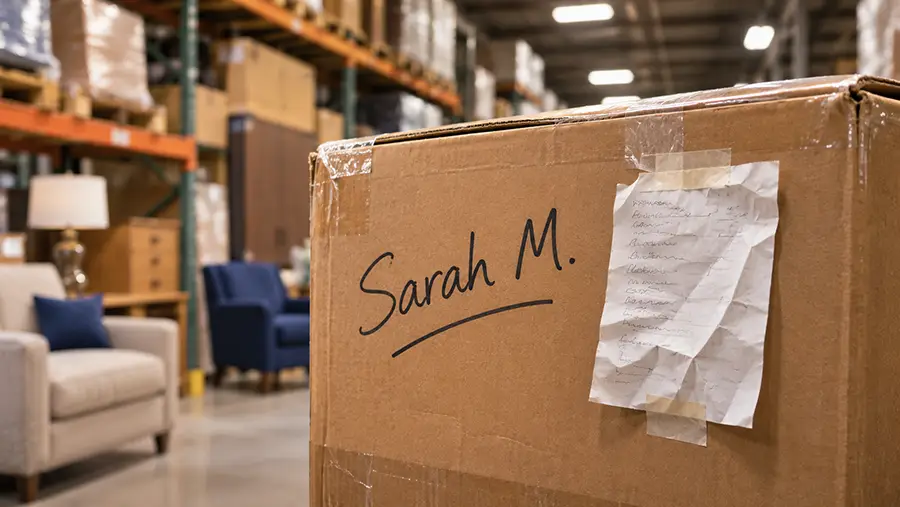
Here's what that looks like on the floor. With generic software, the second you sell something, the system treats it like a bottle of water. It's gone from inventory, as if it was already delivered. So the team prints the receipt, tapes it to the box, writes "Mrs. Johnson" on the side in marker, and tracks the delivery on a spreadsheet or a dry erase board in the back. The system thinks the sofa is gone. The warehouse knows it isn't. And now you're chasing your tail trying to keep paper, boxes, and a whiteboard in sync with reality.
If a software can't handle this, it's generic software. A tiny store might get away with it. But once you're doing more than $300,000 to $400,000 a year, you'll find yourself changing your business to fit the software instead of the software fitting your business.
Special orders deserve their own deep dive, and we've written two: When Should a Furniture Store Order Merchandise for a Special Order Customer? and How Should a Furniture Store Track Special Orders From Sale to Delivery?
2. Will it let you run your business the way you already do?
Every furniture store has its own rules about when things happen on a sale. When is sales tax due? When should inventory get reserved for a customer? Is this item on order for stock, or on order for Mrs. Johnson specifically?
The best furniture software lets you set those rules once and then tracks them automatically. Generic software makes those decisions for you, and they're usually wrong for big ticket retail.
3. Can it handle the way you pay commission?
Commission is one of the biggest headaches in furniture retail, because no two stores pay it the same way. Some pay a flat rate on the sale amount. Some use a sliding scale. Some have a custom structure they've built over years.
Just as important as how much is when. Does the commission become due to the salesperson when the sale is written, when everything is delivered, or when the sale is paid off? Every retailer answers that differently, and every one of those answers is right for that store. The wrong software will force you into its method and tell you, "This is how everybody does it." It isn't.

When commission is done by hand, stores do one of three things, and none of them are good. They simplify the commission structure, not because it's better, but because it's easier to calculate. They pay commission less often, so hourly pay goes out weekly or every two weeks, but commission only goes out once a month because it takes too long to figure out. Now you're running two payroll schedules, and your salespeople are waiting on money they've already earned. Or worse, they run a draw. They pay salespeople on commission they haven't actually earned yet and settle up later. When a salesperson has a slow month, the store has overpaid, and getting that money back is a conversation nobody wants to have.
The best furniture software also keeps a running record of every commission paid, because sales don't always stay the way they were written. If a sale gets refunded or voided, or you have to give a big discount to save it, the profit on that sale changes. Good furniture ERP software goes back and adjusts the salesperson's commission to match, or at least gives you the option to. A lot of software doesn't track the pluses and minuses at all. The commission stays paid, and the loss just lands on the store as an expense you eat.
Your commission plan should be built around how you want to motivate your team, not around what's easy to calculate.
4. Can you control exactly what each employee can see and do?
Every employee has a different history, a different level of trust, and different needs. Your software should reflect that. The best furniture software gives you granular permissions for each person, by number, by function, and by module.
Maybe a salesperson can write a sale but can't give a discount. Maybe a new hire in training can write a sale but can't manager approve a sale. Maybe your team can see the sales report, but not cost or gross margin. You decide, person by person. If your software only gives you "admin" and "not admin," you're either handing out the keys to the whole store or keeping your people from doing their jobs.

Without granular permissions, the simplest thing that goes wrong is theft. Someone gives a refund they shouldn't, edits a sale, changes customer information, or walks money out the door. Even with no bad intent, people break processes when they have access to things they shouldn't touch. And the worst case is someone exporting your entire customer list and opening their own store down the street.
Good software also hides what an employee can't use. If they don't have access to it, why show them the button? Fewer buttons means less confusion and faster training.
5. Can you run the entire business from your phone, anywhere in the world?
Not a laptop. Not a VPN. Your phone. The best furniture software gives owners the complete system from any device with an internet connection.
A lot of software companies will tell you they have a mobile app, but look closer. It's usually a stripped down version where you can check a couple reports, scan some inventory, or maybe write a sale. That's not running your store. If you can't approve a discount, look at your numbers, fix a problem, and manage your team from wherever you are, you're still tied to the building.

I can't tell you how many times I've been out to dinner with my mother in law on a Monday night, and around 8 o'clock she says, "Crap, I forgot to run payroll." She pulls out her phone, runs the entire payroll, calculates every commission, and submits it to the payroll service in about ten minutes. Right there at the dinner table. She couldn't have done that with any software she'd used before.
Access from anywhere should be for the people you choose. The best furniture software lets you lock employee access to specific IP addresses, meaning your team can only log in when they're physically on the store or warehouse network. Owners and managers get in from anywhere. Employees clock in and clock out at work, where they're supposed to be.
6. Does it handle the servers, backups, and updates for you?
You shouldn't need an IT department to run a furniture store. The best furniture ERP software is fully hosted in the cloud and takes care of everything behind the scenes: servers, networking, automatic backups, and updates. No uploading disks, no taking the server down after hours, no restarting anything.
Ask any software company how often they back up your data. Nightly isn't enough on its own. You want frequent backups throughout the day, so if something goes wrong, you lose minutes, not a day of sales. When it's done right, all you need is a laptop or a phone. Everything else is handled.
7. Is everything running on one database?
This is the big one. The best furniture software runs your point of sale, customer records, inventory, price tags, website, and accounting off one single database. Not separate systems that sync overnight. Not a website that gets updated when someone remembers to. One database.

Here's why it matters. A customer walks in, you give them a price, and three seconds later they're standing on your showroom floor looking at your website on their phone, where the same sofa is $50 less. Now you're price matching your own prices, and that $50 comes straight out of your profit. It happens because the floor tag, the register, and the website are all pulling from different places.
When everything runs on one database, you change a price once and it updates on the tag, at the register, and online at the same time. Write a sale, and inventory and the customer record update instantly. There's nothing to keep in sync, because there's only one version of the truth.
8. Is your website built into your software, or separate from it?
A truly integrated website runs off the same database as your store, so everything matches: the products on your site are the products on your showroom floor, availability is real, and the prices are the same everywhere. That matters more than most owners realize. When a customer sees a sofa online, drives in, and finds the same sofa at the same price, they think, "Okay, this company has its act together." When it doesn't match, they start doubting everything you tell them.
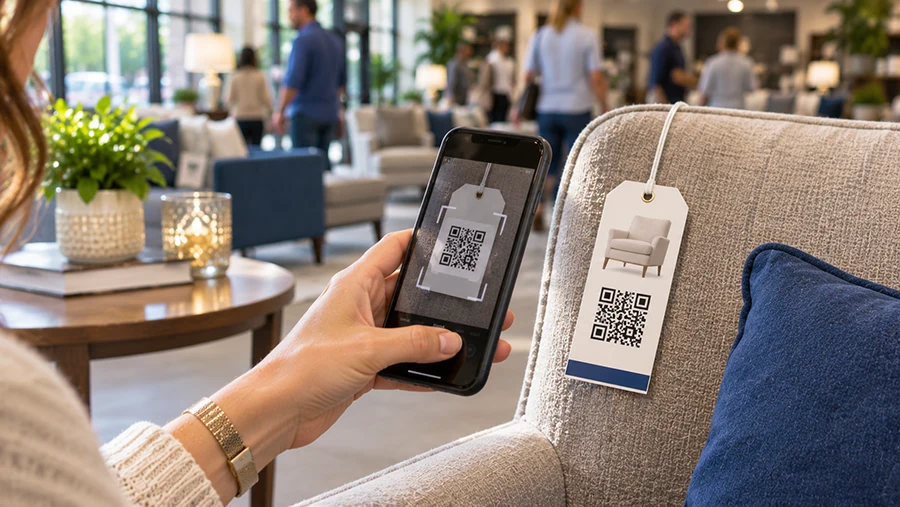
An integrated website also works the floor for you. Put a QR code on every price tag, and customers can scan it and pull up that exact product on your site: availability, pricing, and videos from you or the manufacturer. On a busy Saturday, when every salesperson is tied up, customers can help themselves instead of walking out. Every scan is also a visit to your website, which means your in store shoppers can become part of your online marketing audience. With a website that runs separately from your software, keeping all of that accurate by hand is close to impossible.
9. Does it manage delivery, or just record it?
Without a real delivery module, two things fall through the cracks: what's actually in your warehouse, and what you actually owe your customers.
Remember the box with "Mrs. Johnson" written on the side? Everybody walks past it and says, "Can't touch that, it's for Mrs. Johnson." In reality, Mrs. Johnson got her furniture six months ago, delivered from a different warehouse or pulled off the showroom floor. That box is still sitting there, and nobody knows it's available. Multiply that across a warehouse and you've got cash tied up in inventory you think is spoken for, sitting next to old product that should have been marked down and sold months ago.

The other side is getting the delivery right the first time. Going to a customer's house twice cuts dramatically into your profit. A good delivery module makes sure every item is accounted for before the truck leaves: the right SKUs, the right colors, the right fabrics, the right sizes. You don't forget the second nightstand. You don't forget the rails or the slats for the bed. Without it, errors go up, and your team ends up patching problems with workarounds instead of letting the software do the work.
10. Does it have accounting and management reporting built in?
If your accounting software is separate from your ERP, your books will never match. Not after a software update, not after a better integration, not after another weekend of reconciling. Don't let anybody tell you they will.
A lot of software companies will say their system "ties into" your accounting. Tying in is not the same as matching. Furniture retail has too many moving parts for two systems to agree. A deposit taken today isn't revenue until the furniture is delivered. Cash for the day isn't the same as sales for the day. Your cost of goods depends on freight and on how you track inventory cost. Sales tax might be due when the sale is written or when it's delivered. And every return, void, or discount changes a sale your accounting system already recorded last month.
We hear the same story from almost every retailer who comes to us from a setup like that: no matter what they did, the books never matched. They were doing GL adjustments until the cows came home, trying to make their point of sale, their books, and their tax documents agree.
Here's a simple test for any demo. Ask the software company to walk you through one sale: a deposit taken today, delivered next month, and partially returned the month after. Then ask them to show you exactly where each step lands in the books. If they have to switch programs to show you, or can't show you at all, you have your answer.
When accounting and reporting run on the same database as everything else, there's nothing to reconcile. That's when you can finally answer the question every owner asks at some point: "We sold a lot last month. Where's the money?"
The Number 1 Mistake Retailers Make When Buying Furniture Software
The number 1 mistake retailers make is taking the salesperson's word for it.

You'll hear the same lines in almost every demo. "Your accounting will match your point of sale." It won't if they're separate systems. "We have tons of permissions." Ask them to show you, one setting at a time. "The biggest furniture retailers in the country use us." Maybe so, but that doesn't make it right for you. What works for a 200 store chain with its own IT department can be the wrong fit for a store doing $5 million with one office manager.
The right furniture software is the one that fits how your store actually runs, built on modern cloud technology, with every module you need included, not sold to you one upcharge at a time.
So don't buy the pitch. Take these 10 questions into every demo and make them show you, not tell you. If they can't show you, it doesn't exist.
How EZ Process Pro Checks Every Box
We built EZ Process Pro because, 25 years ago, we were furniture retailers who couldn't find software that worked the way a furniture store actually works. So we built our own, ran our own store on it, and then started helping other retailers do the same. Here's how it lines up against the ten.
Sell today, deliver later. This is the foundation of the system. Every item is tracked as available, reserved, on order for stock, on order for a customer, or delivered. Special orders are built in from the moment the sale is written.
Your rules. Sales tax timing, reserve triggers, and when commission becomes due are all settings you control.
Commission. Commission is calculated automatically on your structure: flat, sliding scale, or custom. When a sale is refunded, voided, or discounted, EZ Process Pro can adjust the salesperson's commission to match instead of leaving the store to eat it.
Permissions. Over 250 individual permissions let you decide exactly what each employee can see and do, and anything they can't use stays hidden.
Anywhere access. The complete software runs on any phone or computer, anywhere in the world, with the option to lock employee access to your store and warehouse networks.
Infrastructure. We're fully hosted on Microsoft Azure. Servers, backups, and updates are handled for you.
One database. Point of sale, customer records, inventory, price tags, website, and accounting all run on one database. Change a price once, and it changes everywhere.
Integrated website. The integrated website and QR code price tags are included. Customers can scan any tag and see real availability, pricing, and product videos. During setup, our launch team helps you add your Facebook and Google pixels to your website, and you can change them anytime. Because every scan lands on your own site, the people who walked your showroom floor can see your ads after they go home, which makes every marketing dollar work harder.
Delivery. The delivery module tracks what's reserved, what's ready, and what's owed, so the truck leaves with everything the first time.
Accounting and reporting. Accounting and management reporting are built in, so your books, your point of sale, and your tax documents match.
Every module is included in the base monthly rate. The only add on is an optional connection to an outside catalog service, and you only pay for it if you use it.
Frequently Asked Questions
What is the best furniture software for independent retailers?
The best furniture software for independent retailers is built specifically for furniture and mattress retail. It should sell today and deliver later, track every item from reserved to delivered, handle custom commission structures, offer granular employee permissions, work completely from a phone, and run point of sale, website, inventory, delivery, and accounting on one database.
What is the best retail mattress software?
The best retail mattress software handles the same things as the best furniture software: future deliveries, special orders, custom commissions, and one database for the store, website, and accounting. Mattress retailers should look for software built for big ticket retail, not a generic point of sale adapted from another industry.
What is furniture ERP software?
Furniture ERP software runs every part of a furniture or mattress store in one system: point of sale, inventory, purchasing, special orders, delivery, commissions, the website, price tags, accounting, and reporting. Because everything shares one database, a change in one place updates everywhere.
Can I use generic retail software for a furniture store?
A very small store might get by with generic software. Once a store does more than $300,000 to $400,000 a year, generic software usually forces the business to change its processes to fit the software. Furniture retail needs software that understands deposits, future deliveries, special orders, and commissions.
Why don't my point of sale and accounting software match?
Separate point of sale and accounting systems never fully agree in furniture retail. Deposits, delivery timing, sales tax timing, freight, cost of goods, returns, and voids are all recorded differently in each system. The only way to make them match completely is to run both on one database.
What should I ask in a furniture software demo?
Ask the software company to show you, not tell you. Have them walk one sale from deposit to delivery to a partial return and show where each step lands in the books. Ask to see the permission settings, the commission setup, and the full system running on a phone.

|
Fit the Software to Your Store, Not the Other Way AroundRunning a furniture or mattress store is hard enough. Your software shouldn't add friction to a business that already has plenty. The best furniture software fits the way you already run your store, keeps one version of the truth, and lets you run the business from anywhere. Take these 10 questions into your next demo. And if you want to see how EZ Process Pro answers every one of them, schedule a demo with our team. |

|
About the AuthorAlan Lucien is the founder of EZ Process Pro. Before building software, he and his family ran their own furniture store. For the past 25 years, he has built software for independent furniture and mattress retailers that works the way a furniture store actually runs. |