 EZ Process Pro

Why More Marketing Won't Save Your Furniture Store (And What Will)
A Guide for Independent Furniture and Mattress Retailers Who Want to Stop Losing Money They Don't Know They're Losing
I want to tell you about someone I watched lose six furniture stores.
I won't say who it is. It's too close. But I will tell you this: he was one of the hardest-working people I've ever known. Always pushing. Always selling. His answer to every problem, whether it was cash flow, team issues, or slow months, was the same. Sell more. Market more. Bring in more revenue. That will fix it.
It didn't fix it. And I watched it happen in real time.
Here's what I learned watching that man's business slowly sink: you can have a record sales week and still not be able to pay your bills. We've seen it with our own clients. Revenue is not the same thing as profit. And the stores that fix this aren't marketing less. They're using furniture ERP software to find the money they're already losing. Marketing more when you have holes in your ship doesn't save the ship. It just delays the sinking.
The Ship Analogy Nobody Wants to Hear
When I talk to retailers who are struggling, I use this image: your business is a ship with holes in the hull. Every time you pour more marketing dollars in, you're bringing more water onto a ship that's already taking on water through the bottom.

The retailers who thrive don't just sell more. They also find the holes and close them. And in our experience working with hundreds of furniture and mattress retailers over 25 years, the holes are almost always in the same places.
Why Furniture Stores Lose Money (Even When Sales Are Strong)
Most furniture and mattress retailers are losing money in ways that never show up on a sales report. Here is where it actually goes.

Excess inventory. A store carrying $1.2 million in inventory may have $150,000 to $300,000 tied up in products that haven't sold in over 180 days. That furniture is paid for. It's taking up floor space. And it's generating nothing.
Aged inventory that nobody is tracking. Partial shipments are one of the worst offenders. You ordered a full bedroom set, one piece didn't arrive, and now a headboard has been sitting in the warehouse for eight months waiting on a nightstand. That cash is frozen and nobody is managing it out.
Uncollected financing. This one stops retailers cold when they see it for the first time. The furniture has been delivered. The customer has it in their home. But nobody submitted the paperwork to the financing company to collect payment. We've seen stores discover tens of thousands of dollars in uncollected financing after implementing better reporting. The sale was closed. The money just never arrived.
Poor delivery scheduling. Sales that are fully reserved and staged in the warehouse but never scheduled for delivery create a double problem. The cash isn't coming in and the warehouse space is locked up. Calling Miss Johnson to schedule her delivery should not require a manager to dig through notes.
Pricing inconsistencies across systems. When your website, your floor tags, and your point of sale don't share the same database, prices drift. Your team is working off different numbers than your customers are seeing online. That erodes trust and it costs real money in margin errors and returns.
Lack of visibility. The most expensive problem is the one you can't see. When your data lives in spreadsheets and disconnected systems, you don't know what you don't know. Owners find out there's a problem when they look at the bank account, not when there's still time to fix it.
7 Warning Signs Your Furniture Store Has Profit Leaks
If you recognize more than two of these, the problem is operational, not market-driven.

- Inventory over 180 days old. If you can't name the SKUs that haven't moved in six months, they exist. They're just invisible to you right now.
- Delivered sales awaiting finance funding. Furniture is in the customer's home and the money hasn't come in. This is more common than most retailers want to admit.
- Excess partial shipments piling up. Half a bedroom set in the warehouse is half a bedroom set's worth of cash sitting idle.
- Warehouse full but cash is low. This is almost always an inventory and receivables problem, not a sales problem.
- Prices don't match between systems. Your website says one thing. Your tags say another. Your POS says a third. One version of truth doesn't exist in your business yet.
- Manual spreadsheets everywhere. When your team is maintaining separate spreadsheets for inventory, deliveries, and customer follow-up, accuracy is a matter of luck.
- You can't explain last month's profit. You know what you sold. You don't know what you kept. That gap is the problem.
Where the Money Actually Goes
When a furniture retailer comes to us and says, "I made a million dollars last month. Where's the money?" the answer is almost always one of two things.
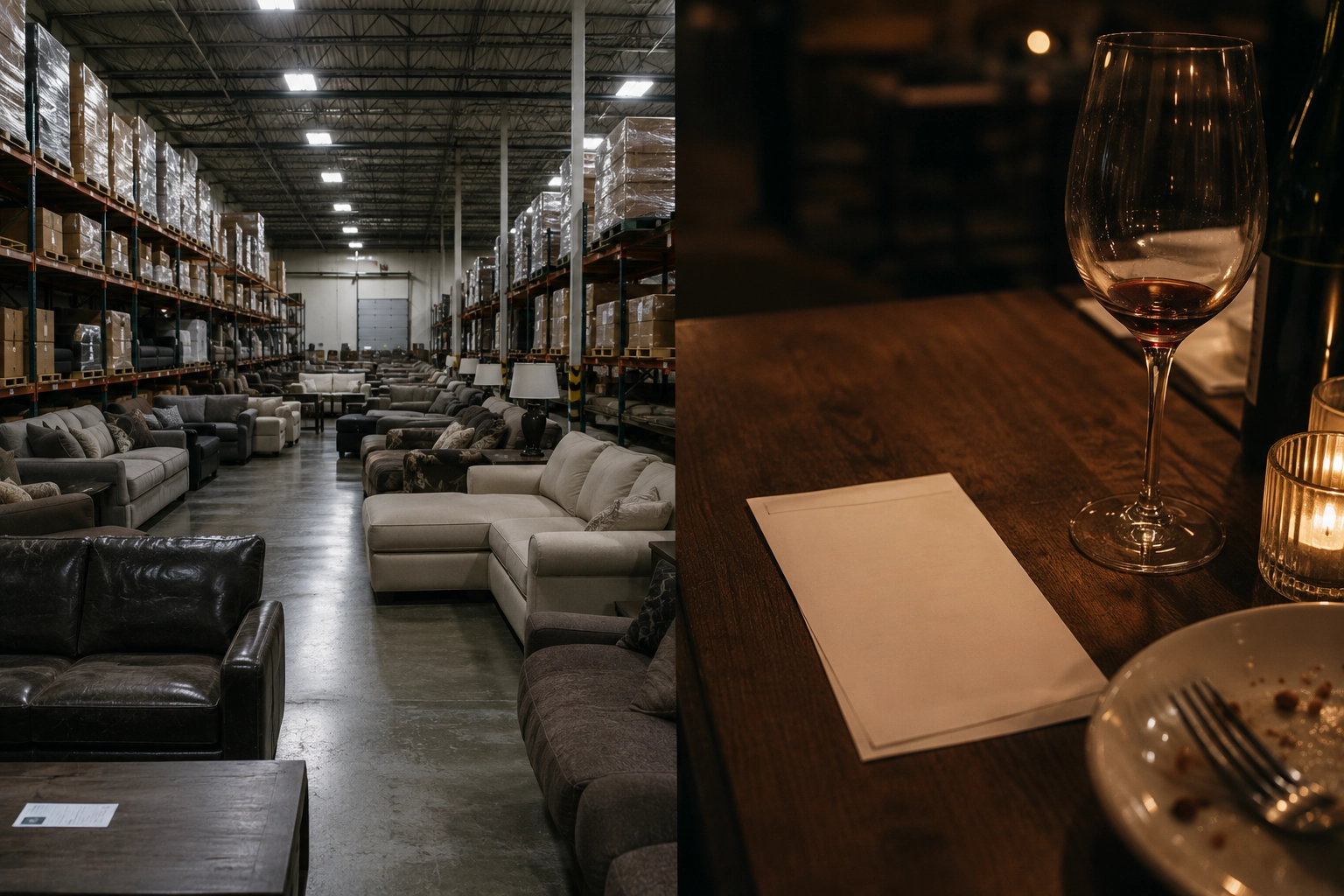
It's tied up in inventory.
Not just inventory in the general sense. I mean a headboard sitting in the warehouse for eight months because you couldn't get the rest of the set delivered. An extra nightstand. A chair from a sofa and loveseat that never made it out the door. Partial shipments piling up because you had to order ten thousand dollars worth of sofas to meet a vendor minimum when you only needed one.
That furniture is paid for. It's not generating a dime. And for most retailers, there's more of it than they realize until they actually look.
Or it walked out the door personally.
This one's uncomfortable, but it needs to be said. A lot of furniture store owners use their business account like a personal account. The trip to Cabo goes on the business card. The dinner, the car payment, the random expenses. And because they're not actually tracking it as a personal draw, they're not budgeting for it either. It just quietly disappears, and then they wonder why the cash isn't there.
There are other holes too. Sales where the furniture is in the customer's house and nobody went back to collect payment from the financing company. Inventory that walked out the door without anyone noticing. Old SKUs that haven't moved in a year still sitting on the floor taking up space. All of it is money that exists on paper but isn't actually working for you.
What Retailers Say When You Tell Them This
Most push back. Hard.

"We don't have those problems." "You don't understand our business." "That's not how we operate."
And honestly? That response makes sense if you think about what's underneath it. Because if they admit the holes exist, they have to deal with them. And dealing with them means work. It might mean difficult conversations with the team. It might mean finding out the person they trusted most has been sloppy with inventory. It might mean admitting that the real problem isn't the market or the economy or their competitors. It's operational, it's fixable, and they've been avoiding it.
I've watched retailers convince themselves their situation is unique. That the rules that apply to hundreds of other stores somehow don't apply to them. It's not arrogance. It's fear. The internal dialogue sounds something like: what if we look and the problems are too big? What if we don't have the people or the systems to fix them? What if I've already made too many mistakes?
That fear is normal. But letting it run the business is how stores go under.
The 10% Rule (And Why It's Not What You Think)
Here's where I might surprise you. We believe you should always spend 10% of your revenue on marketing. Always. Up economy, down economy. COVID years, tariff years. Always.

But notice what that number does automatically: if your revenue drops, your marketing spend drops proportionally. You're not making a panicked decision to cut marketing when things get slow. You're just spending a consistent percentage of what's coming in. It regulates itself.
And marketing doesn't just mean Facebook ads and billboards. It means sponsoring the local Little League team. It means showing up on video so people in your market know who you are and what you stand for. It means building authority so that when someone in your town is ready to buy a mattress, they already know your name.
Marketing matters. It always matters. But it is not a substitute for operational health. A great marketing campaign sends more people into a store that has holes. All you've done is show more people the problems.
How Furniture ERP Software Helps Close Profit Leaks
When retailers come onto EZ Process Pro, they're usually running things the way they always have. Orders are tracked one way, inventory another. The website has different prices than the floor tags. Nobody is getting flagged when a sale sits reserved in the warehouse without a delivery call.

Furniture ERP software fixes this by putting every part of the operation into one system that shares a single database. Here is what that looks like in practice.
Inventory tracking. Every product in your store, your warehouse, and on order is visible in real time. Aged inventory surfaces automatically. You don't have to go looking for the problem. The system tells you.
Purchase orders. Buying decisions are tied directly to what's actually moving. You stop over-ordering to hit minimums without a plan for what to do with the excess. Partial shipments are tracked until they're complete.
Financing workflows. Every financed sale is flagged until the paperwork is submitted and payment is confirmed. No more furniture sitting in a customer's home with uncollected receivables attached to it.
Delivery management. Sales that are ready for delivery get surfaced automatically. Miss Johnson gets a call because the system tells someone to make it, not because a manager happened to check a spreadsheet.
Customer management. Every interaction, every order, every service issue lives in one place. Your team has the full picture when a customer calls. That reduces mistakes, reduces returns, and keeps good customers coming back.
Reporting. This is where furniture store management software changes the conversation for owners. Instead of finding out about a cash problem when you look at the bank account, you see it developing in the reports weeks earlier. Gross margin by category. Inventory turn by vendor. Delivery completion rates. You manage the business on data instead of instinct.
In the first 45 days on EZ Process Pro, retailers consistently find things they didn't know were there. A specific SKU that hasn't moved in months, tying up $40,000 or $80,000 in cash. Staged deliveries that were never scheduled. Finance deals that were delivered but never collected.
That's not a software story. That's a profit story.
The Question That Changes Everything
In 25 years of working with furniture and mattress retailers, we've asked this question hundreds of times:

To increase profit by $200,000 this year, what's easier? Grind out more marketing to close more sales, or find and close $200,000 worth of holes that are already bleeding you dry?
Every single time, the answer is B.
The retailers who figured that out first are the ones posting vacation photos from expensive places with their families while the store keeps running without them. That's not luck. That's what happens when you stop patching the hull from the deck and actually get below the waterline.
Fix the ship first. Then sell more. In that order.
Frequently Asked Questions

Why is my furniture store not profitable despite strong sales?
Revenue and profit are two different numbers. Strong sales can hide serious operational problems. The most common causes are excess inventory tying up cash, uncollected financing from delivered sales, poor inventory turnover on aged product, and pricing inconsistencies between systems. Many stores doing over $1 million in annual revenue have $150,000 or more in fixable losses they aren't aware of yet.
How much inventory should a furniture store carry?
There is no universal number, but inventory should turn regularly and aged product should be monitored closely. As a general rule, any product that hasn't sold in 180 days deserves a hard look. Retailers carrying $1.2 million in inventory often find that 15% to 25% of it is effectively frozen cash that isn't contributing to profit.
What is furniture ERP software?
Furniture ERP software combines inventory management, point of sale, purchasing, customer management, delivery scheduling, and financial reporting into one connected system. The key difference from using separate tools is that all of your data lives in a single database. When a price changes, it changes everywhere. When a sale is made, inventory updates instantly. When a delivery is completed, the financing workflow is triggered automatically.
How can furniture retailers improve cash flow?
The fastest wins usually come from four places: reducing aged inventory by identifying and clearing stale product, collecting financing promptly by tracking every financed sale to confirmed payment, improving purchasing accuracy to avoid over-buying, and increasing inventory turnover by selling what's in stock before ordering more. Furniture retail software makes all four of these visible and manageable in one place.
Does furniture store management software work for mattress retailers too?
Yes. Mattress retailers face the same operational challenges: aged inventory, uncollected financing, delivery scheduling gaps, and disconnected systems. The same software that helps a furniture store get visibility across its operation works equally well for mattress retailers, and for stores that carry both.
Ready to find out where your store is bleeding money? EZ Process Pro is a full-service ERP platform built by furniture and mattress retailers, for furniture and mattress retailers. Most stores find it within the first 45 days.